Why Microservices?
Navigating the Jungle of Software Complexity: Why It's Time to Embrace Microservices!
In the rapidly evolving landscape of software development, the complexity of applications continues to grow, presenting a significant challenge for teams tasked with their creation and maintenance. As we aim to meet the increasing demands for feature-rich, reliable, and scalable applications, the traditional monolithic approach to software architecture often falls short. This is where microservices come into play.
Microservices architecture, a method of developing software systems as a suite of small, independent services, offers a solution to the complexities faced in modern software development. Unlike the monolithic approach that bundles all components into a single, intertwined unit, microservices enable teams to build, deploy, and scale each part of an application independently. This flexibility significantly enhances agility, facilitates continuous delivery, and improves system resilience.
The transition to microservices is driven by advancements in cloud infrastructure, tooling, and automation technologies, making it more accessible than ever to adopt this architectural style. By breaking down applications into microservices, organizations can avoid the pitfalls of the monolithic architecture, such as difficult scaling and cumbersome updates, and instead, embrace a model that supports the dynamic needs of today's digital products.
Our journey through this blog series will demystify microservices, guiding you from the conceptual to the practical implementation of a microservices-based application. We'll explore how to leverage these architectural principles to build a scalable and resilient video-streaming platform, showcasing the tangible benefits of microservices in real-world application development.
Embracing microservices is not just a technical decision but a strategic move towards future-proofing your applications and staying competitive in the digital era.
Microservices: Little Digital Helpers with Big Responsibilities
Microservices are akin to the industrious elves of software development—small, autonomous units that manage their functionalities independently within the larger ecosystem of an application. Despite their diminutive size, microservices carry significant responsibilities, operating on individual deployment schedules and undergoing updates without the need for a synchronized release with other components.
This architectural approach enables a high degree of agility and resilience, allowing each service to perform its specific role effectively without impeding the functionality of others. As a result, even as the application grows in complexity, the foundational simplicity and manageability of each microservice remain intact.
Adopting microservices means embracing a model where the application evolves and scales organically. This strategy not only mitigates the risks associated with large-scale, monolithic architectures but also enhances the development team's ability to respond to changes and deploy new features swiftly.
By the conclusion of this exploration, you'll have a comprehensive understanding of how microservices function as the building blocks of modern software, empowering you to architect and maintain scalable, flexible applications. Prepare to navigate the intricacies of microservices architecture with confidence, transforming complexity into a harmonious symphony of independent yet interconnected services.
The Anatomy of a Microservices Application
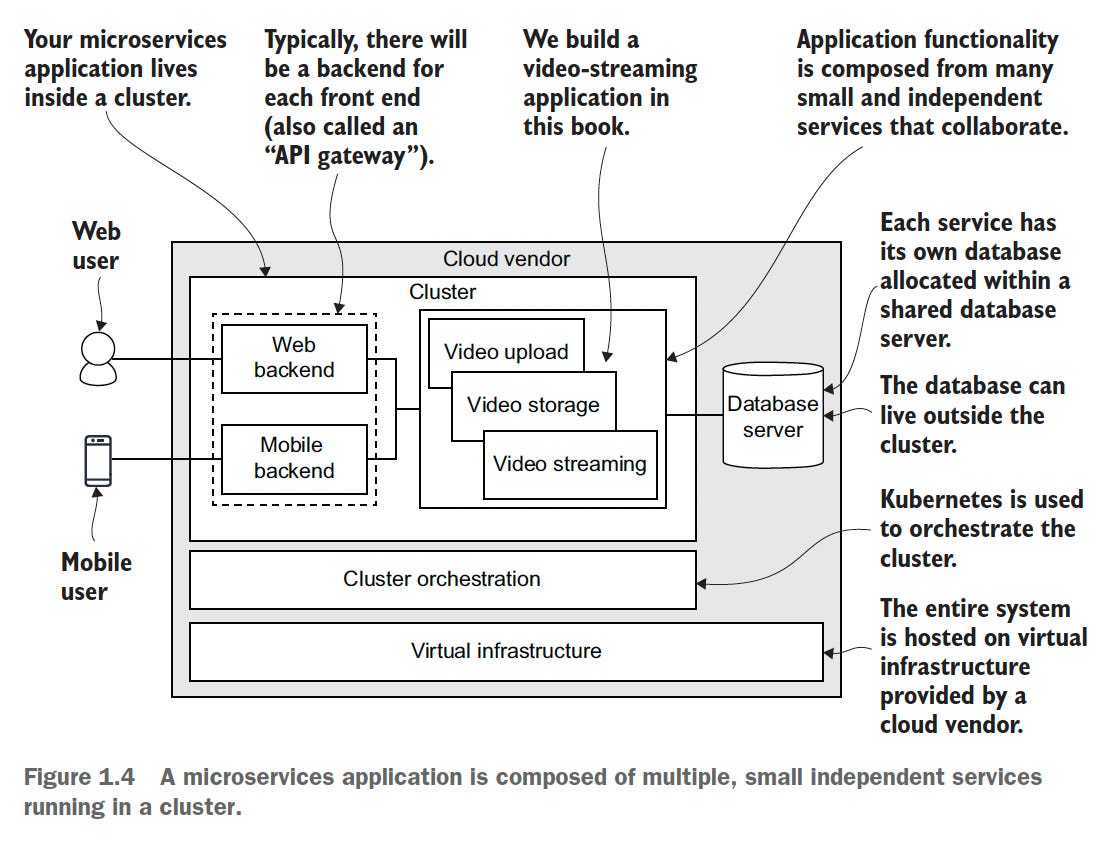
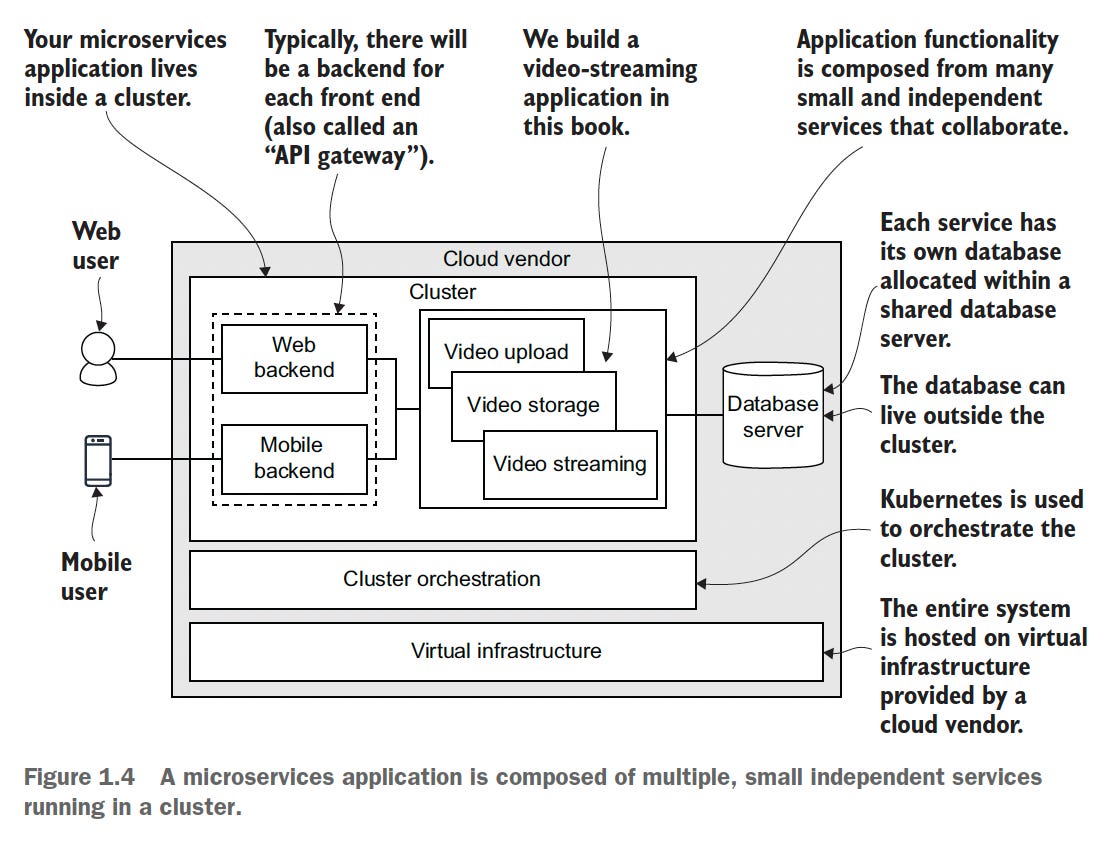
In software engineering, a microservices application represents a sophisticated distributed system, analogous to a well-coordinated orchestra. It consists of numerous small, independent services, each operating in its own process and communicating across a network. These services function like soloists, each with a specific role, contributing to the collective performance of the application.
A microservices architecture typically features services that interface directly with users, offering gateways for web and mobile interactions. These services operate within a digital cluster, a cohesive unit of computational resources, with a data store situated either within or external to this cluster, depending on design preferences.
Kubernetes emerges as the pivotal orchestration platform, managing the deployment and operation of services within the cloud infrastructure. This orchestration ensures that services are efficiently managed, allowing for scalable and resilient application performance.
The cloud-based infrastructure of a microservices application, which can be deployed on platforms like Microsoft Azure, AWS, or Google Cloud, offers unparalleled flexibility. This setup enables the architecture to be customized to meet the diverse needs of different business domains and customer requirements, demonstrating the architecture's adaptability and scalability.
In essence, microservices applications provide a modular approach to software development, allowing for precise control over each component's functionality and facilitating a more agile development and deployment process.
[
Reassessing the Monolithic Architecture
The concept of a monolithic architecture has been a staple in the development landscape, long before the advent of cloud computing and the popularization of microservices. A monolithic application is a single-tiered software application in which different components and functionalities are interconnected and interdependent, forming one unified codebase.
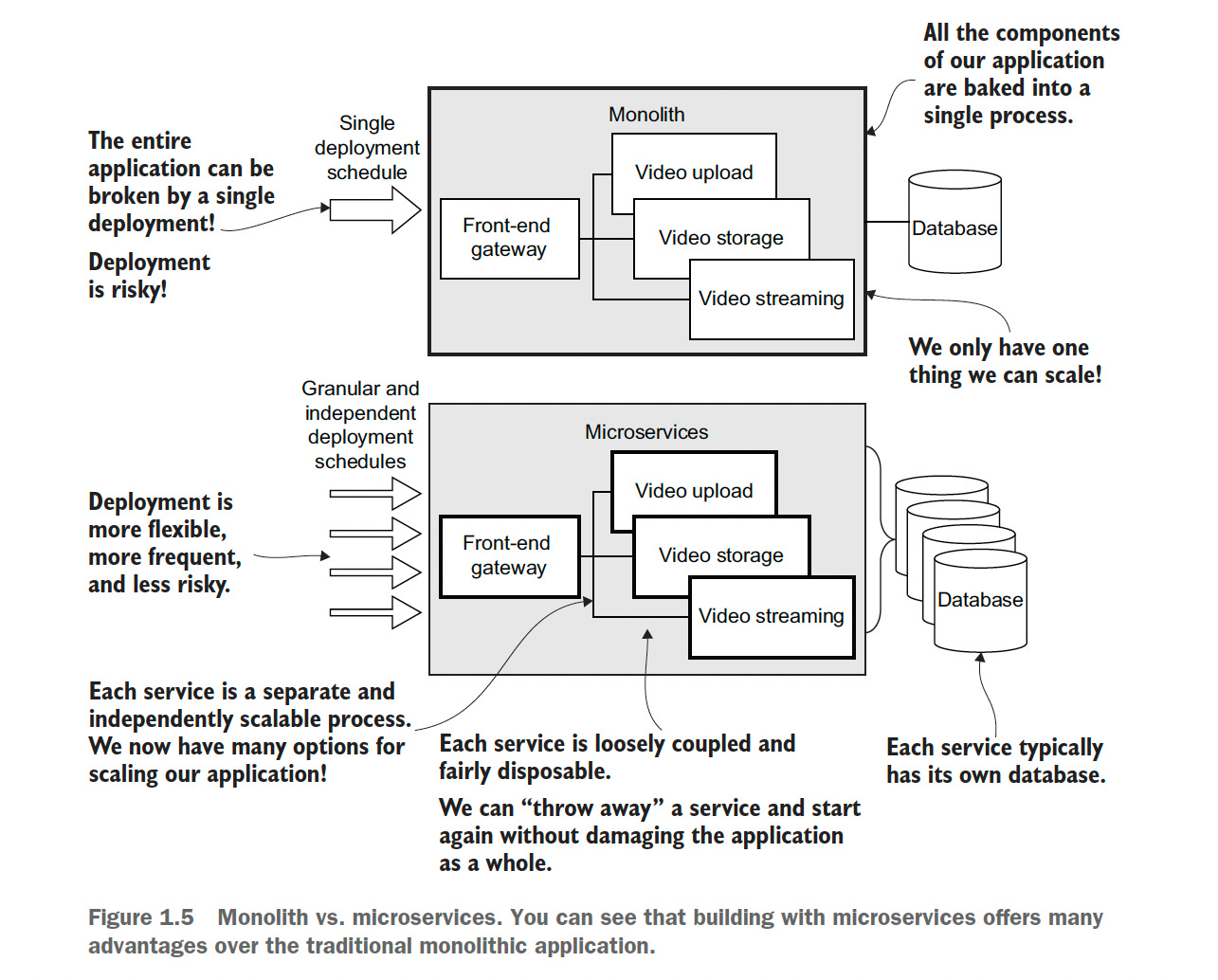
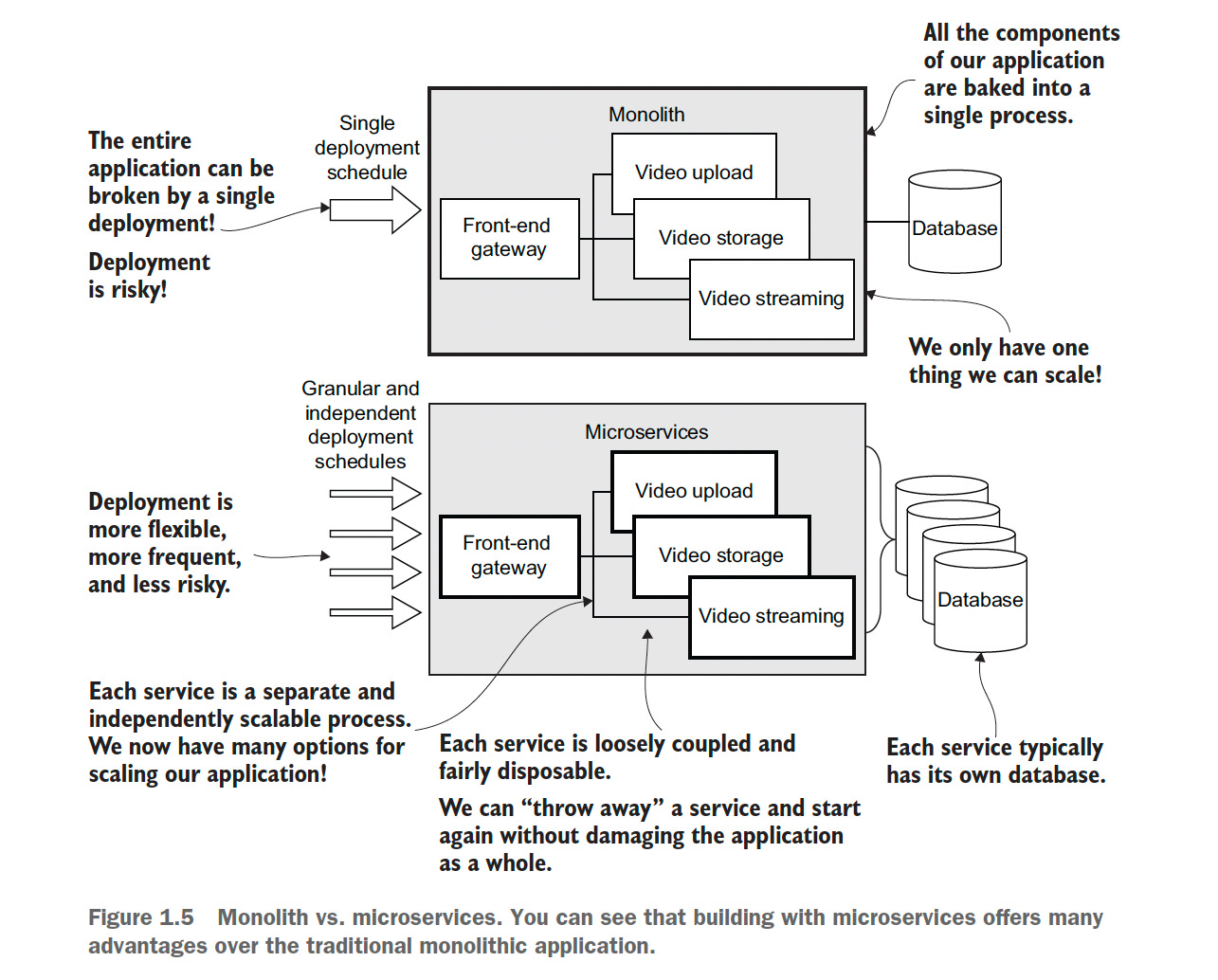
However, with the evolution of technology and the shift toward more agile and scalable solutions, the limitations of monolithic architectures have become apparent. Monolithic systems, by their nature, can present significant challenges in scaling, as every aspect of the application must be scaled in unison, regardless of individual component needs. This lack of modularity can also lead to complexities in continuous integration and deployment processes, making it cumbersome to implement and roll out updates and improvements efficiently.
The adoption of microservices is often seen as an answer to these challenges. By breaking down an application into smaller, loosely coupled services, each running its own process and communicating through well-defined interfaces, organizations gain the ability to scale and update components independently. This results in enhanced flexibility, more manageable codebases, and improved resilience of the overall system, making it a preferred choice for contemporary application development, particularly in cloud environments.
In the context of a video-streaming application, the contrast between a monolithic and a microservices architecture can be stark. The former may encapsulate all services within a single, indistinguishable mass, whereas the latter distinctly delineates services such as user authentication, video processing, content delivery, and data management into separate, autonomously deployable services, demonstrating clear benefits in terms of scalability, manageability, and innovation velocity.
[
It is much easier to build a monolith than a microservices application. You need fewer technical and architectural skills. It’s a great starting point when building a new application, say for an early stage product, and you want to test the viablilty of the business model before you commit to higher technical investment required by microservices application.
The Advantages of Adopting a Microservices Architecture
The transition to a microservices architecture heralds a multitude of benefits for building distributed applications. Within this paradigm, each service is afforded the opportunity for dedicated computational resources, such as CPU and memory. Typically, resources are shared across services to enhance cost efficiency. However, the architecture retains the flexibility to allocate dedicated resources to more demanding services as needed, facilitating independent scalability and allowing for nuanced performance optimization.
Key advantages of microservices include:
- Enhanced Scalability Control: Microservices grant developers the ability to exercise granular control over the scalability of individual application components.
- Diminished Deployment Risk: The architecture minimizes the potential for widespread disruption during deployment, thus accelerating the development process.
- Technological Freedom: It permits the selection of an optimal technology stack for each service, freeing developers from the constraints of a monolithic architecture's uniform tech stack.
Distributed applications inherently offer improved reliability and a reduced deployment risk profile. When updates are applied to a single service within a microservices structure, they can be executed without jeopardizing the entire application's stability. Should any issues arise, it is considerably simpler to revert changes in a discrete service rather than in an entire monolithic system. This reduction in deployment risk encourages more frequent updates, which is critical for maintaining agility and a swift development cadence.
While the concept of distributed applications is not revolutionary, the affordability and advanced tooling available today make the construction of such systems more accessible and efficient than ever. As the industry has evolved, the trend towards smaller, service-oriented components has become prevalent, bringing with it a suite of distinct advantages. Notably, the reduced startup time of smaller services significantly enhances system scalability, allowing for rapid replication of services under high demand, thus ensuring robust performance and user satisfaction.
Addressing the Challenges of Microservices
In discussing the merits of microservices, it is essential to confront the primary concerns that often arise:
1. The Challenge of Complexity: The complexity inherent in microservices architectures is undeniable. It extends beyond the intricacies of the technologies involved to encompass the principles and practices required to construct distributed systems. While daunting, the resources at hand—this guide included—aim to streamline the learning process, equipping you with the knowledge to navigate this complexity effectively.
Note: The prospect of tackling such a vast topic can be intimidating. However, the evolution of tooling in this domain has been significant. Today's tools boast greater sophistication, usability, and, crucially, automation capabilities.
2. The Intimidation of Learning: The learning curve associated with these technologies is steep, and mastering them independently could be a prolonged endeavor. Nevertheless, the approach herein is to focus on the essentials necessary for initiating a production-ready application. This will not only yield a functional microservices architecture but also impart fundamental insights into distributed system design.
The reality is that constructing a microservices-based application, or any distributed system, presents a more elaborate undertaking compared to a monolithic counterpart. At the outset, a monolith may appear simpler and in certain contexts, it might be the preferable choice. Yet, it's imperative to contemplate the long-term implications and the potential complexity of transitioning to microservices at a later stage.
Complexity in software development is a given—it will arise and evolve over time. The aim is not to shun complexity but to master it. Microservices architecture serves as an essential framework in this regard, offering a proactive strategy to tackle complexity early in the development lifecycle.
Microservices architecture brings forth numerous advantages, including:
- Defined boundaries that mitigate the risk of entangled code.
- Enhanced flexibility for modifications, scaling, and updates.
- Promotion of robust design principles.
Ultimately, microservices enable us to manage complexity more effectively, offering a structured approach to tackle the sophisticated demands of modern software development. The investment in understanding and applying microservices pays dividends in the form of a scalable, manageable, and future-proof digital infrastructure.
Exploring the Cutting-Edge Tooling for Microservices
The core focus of this text is to delve into the extensive tooling available for building and managing microservices. The initial step in this journey is the creation of a microservice itself. We will leverage JavaScript and Node.js for this endeavor, with an upcoming series dedicated to covering the foundational aspects of these technologies.
Node.js is selected for its efficiency and suitability; however, it's important to note that within a microservice framework, the choice of technology stack is flexible. Alternative languages such as Python, Ruby, Java, or Go are equally viable options for service construction.
Throughout this blog series, we will explore a range of pivotal tools:
- Docker: Essential for encapsulating services into containers, facilitating both portability and deployment.
- Docker Compose: Allows for the orchestration and testing of our microservices on local development environments.
- Kubernetes: Empowers cloud hosting and management of our application, providing robust scaling and orchestration.
- Terraform: Utilized for constructing and deploying cloud infrastructure, including Kubernetes clusters, streamlining the deployment process.
In the ever-evolving landscape of technology, tools may come and go, raising the question of the value in learning a specific set. The answer lies in the continuous need for proficient tools that augment our capabilities, enabling us to work with greater efficacy and productivity.
The selection of tools presented in this guide is made based on their capacity to simplify and accelerate the development of microservices architectures. While change is inevitable, the current toolkit is robust, popular, and occupies an essential space within the developers' arsenal.
As we progress, it is anticipated that these tools will be superseded by even more advanced solutions, elevating the level of abstraction and further simplifying our tasks.
Among the suite of tools, Docker has achieved near-universal adoption, rapidly becoming integral to our industry. Kubernetes, while not as widespread as Docker, is poised for a significant future, offering a means to navigate the limitations of cloud service providers.
Terraform, a relatively recent addition, revolutionizes infrastructure management by enabling developers to define and provision cloud resources through a declarative syntax. Its compatibility with various cloud vendors ensures its relevance regardless of the chosen provider, obviating the need to learn different languages for different clouds.
Reflect on the concept of 'infrastructure as code' introduced by Terraform. This transformative approach to infrastructure management is essential for continuous delivery—a practice at the heart of contemporary software development that will be further discussed in later blog posts in the series.
Principles of Microservices Application Design
This text is designed to be practical; however, a brief exploration of software design principles is essential before we delve into the practical application. While this book will lay the groundwork, a wealth of literature is available for those seeking to deepen their understanding of software design.
Designing a microservices application is fundamentally similar to other software design processes. Classic software design principles remain relevant and can be effectively adapted to the microservices paradigm. Nonetheless, certain practices are particularly crucial when approaching microservices:
- Simplicity in Design: Avoid overcomplicating or attempting to future-proof the architecture. Begin with a straightforward design.
- Ongoing Refinement: Embrace continuous refactoring throughout the development process to maintain simplicity.
- Natural Evolution: Allow the design to evolve organically, as a prescriptive approach is not suitable for complex microservices architectures.
Microservices particularly embody the principle of emergent design. It's impractical to predefine the full architecture of a substantial microservices system; it must develop progressively through both the development phase and the application’s lifecycle.
Strategic planning is unquestionably vital at each stage, yet it should be flexible enough to accommodate changes. Microservices excel in facilitating swift adaptation to evolving requirements. With these overarching rules in mind, we turn our attention to three principles especially pertinent to microservices:
- Single Responsibility Principle: A microservice should be confined to a single business concept or domain, ensuring clarity of purpose and functionality.
- Loose Coupling: Services should interact minimally, sharing data only when necessary. This minimizes dependencies and facilitates independent service updates, contributing to an application’s adaptability.
- High Cohesion: The internal elements of a microservice should be coherent and united in addressing the service’s dedicated functionality. Deviation from this suggests a need for further modularization.
Domain-Driven Design (DDD), as formulated by Eric Evans in his seminal work, is an effective framework for microservices. DDD's emphasis on bounded contexts aligns well with defining the perimeters of microservices, supporting a clear delineation of responsibilities within the system.
To illustrate, consider the domain of a video-streaming application: entities like User, Like, and Video would be encapsulated within microservices, with certain entities also delineating the inter-service relationships. This approach ensures each service is a reflection of the business domain, facilitating a robust and intuitive architecture.
Developing a Microservices Application: The RetailLoopTube Case Study
Upon concluding this series, readers will have acquired the knowledge and practical experience to construct a comprehensive microservices-based application. As we navigate through this educational journey, our guiding example will be the development of a video-streaming platform. After considerable deliberation, the chosen name for this hypothetical yet illustrative product is RetailLoopTube, envisioned to be a leading contender in the video-streaming domain.
The rationale behind selecting video streaming as our example is twofold. Firstly, it presents an engaging and accessible project that, despite its apparent complexity, is quite feasible to implement in a simplified version. Secondly, video streaming epitomizes a scenario where microservices architecture has been leveraged to great effect, as evidenced by industry pioneers like Netflix, known for operating an extensive microservices infrastructure.
The RetailLoopTube project will serve as a practical framework to explore the construction and deployment of a microservices architecture. Although the initial scope includes a limited number of services, the architecture is designed with future expansion in mind. This includes considerations for increasing the cluster's computational resources, scaling services for enhanced performance and redundancy, and modularizing the codebase to facilitate independent development cycles and team management.
Key functionalities of the RetailLoopTube application will encompass video streaming, storage, and upload capabilities, complemented by a customer-facing gateway. The user interface will enable viewers to browse and play videos seamlessly. Throughout the series, we will employ Docker Compose for local development and simulation, delve into the creation and distribution of Docker images, and guide the deployment process to a production environment. Additionally, the series will revisit development practices to integrate automated testing strategies.
By the time we reach the latter segments of the series, the focus will shift towards scalability and the diverse ways the microservices architecture can accommodate the growth of the RetailLoopTube platform.
This comprehensive series is structured to equip readers with the insights and skills required to embark on their microservices development journey. Whether you are a novice seeking to understand the basics or a seasoned developer aiming to refine your microservices strategy, this exploration of RetailLoopTube will provide a valuable and professional perspective on building scalable, resilient software architectures.
Conclusion
If you don’t want to wait for the whole series to end to get the knowledge, you can buy my ebook on gumroad => Microservices . To encourage to keep up the pace with writing this blog post, you can buy me coffee with the button below
Originally published on substack
Enjoyed this?
Subscribe to get new essays in your inbox.